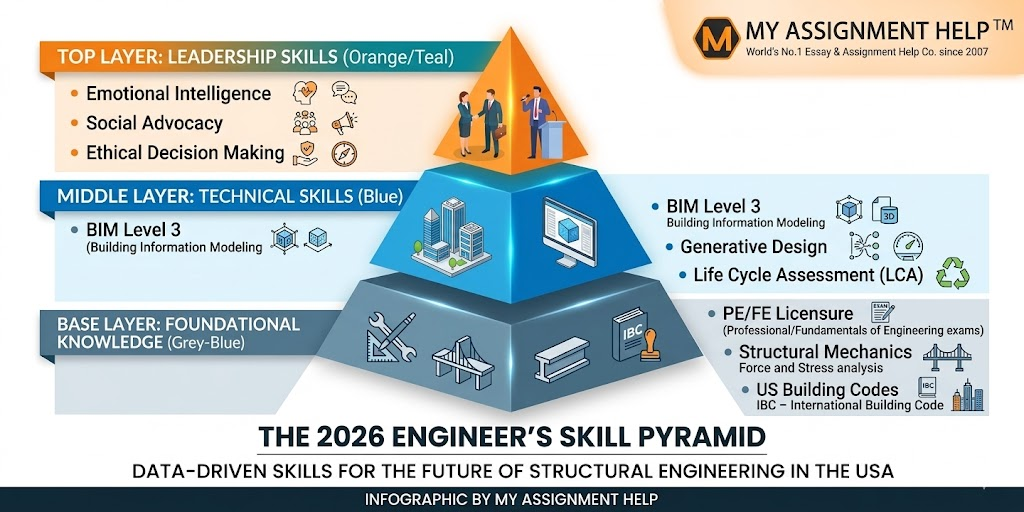
The skyline of the United States is undergoing a radical transformation. From the implementation of resilient infrastructure in coastal cities to the integration of carbon-neutral materials in Midwestern hubs, the role of the structural engineer is no longer confined to static calculations. For recent graduates entering the workforce in 2026, the baseline for “competence” has shifted from traditional mechanics to a sophisticated blend of digital fluency and social responsibility.
As the American Society of Civil Engineers (ASCE) continues to emphasize the “Grand Challenge” of reducing life-cycle costs of infrastructure by 50% by 2025, the pressure on the next generation of engineers is immense. To thrive in this high-stakes environment, graduates must look beyond the textbook and master a multidisciplinary toolkit.
Digital Twins and AI-Driven Design
The days of manual 2D drafting are long gone. Today, the US construction industry relies heavily on Digital Twins—dynamic virtual models that evolve alongside their physical counterparts. Grads must be proficient in BIM (Building Information Modeling) software like Revit and Navisworks, but the future lies in Generative Design.
AI algorithms can now iterate thousands of design permutations based on specific constraints like weight, material cost, and wind resistance. This allows engineers to choose the most efficient structure before a single shovel hits the ground. Mastering these computational design tools is critical for those aiming to work for top-tier firms in cities like New York or San Francisco.
Navigating the Rigors of Professional Licensure
The path from a student to a Professional Engineer (PE) in the United States is notoriously difficult. With the NCEES (National Council of Examiners for Engineering and Surveying) constantly updating the FE and PE exams to include more technical software questions, academic preparation has never been more intense. Many students find that the transition from general physics to specialized structural analysis requires targeted support. Whether it’s mastering finite element analysis or understanding complex loading codes, seeking help with assignment online can provide the conceptual clarity needed to maintain a high GPA while preparing for licensure. This supplementary academic focus ensures that grads don’t just pass their classes but actually retain the core principles required for real-world safety.
Sustainability and “Green” Structural Integrity
With the US government’s push toward net-zero emissions, structural engineers are now at the forefront of the climate fight. Grads must understand the embodied carbon of materials. This involves moving beyond standard steel and concrete to explore mass timber, recycled aggregates, and carbon-infused cement.
According to data from the U.S. Green Building Council (USGBC), buildings are responsible for nearly 40% of global energy-related carbon emissions. Therefore, an engineer’s ability to design for “deconstruction”—where materials can be repurposed at the end of a building’s life—is becoming a highly sought-after skill in the American job market.
Ethics, Advocacy, and Social Impact
Engineering does not happen in a vacuum. Every bridge built or skyscraper erected has a social consequence. Modern US firms are looking for engineers who understand Environmental Justice and how infrastructure impacts local communities. Developing a “Social Speech” or a professional voice for advocacy is now a core competency. For those looking to broaden their perspective, exploring the Best Social Issues Topics for Students can help future engineers understand the intersection of urban planning and societal equity. Being able to explain technical structural decisions to a non-technical town hall committee is just as important as the math behind the structure itself.
Key Takeaways
- Software is King: Proficiency in AI-driven BIM and Generative Design is non-negotiable for 2026 grads.
- Licensure Matters: Early preparation for the FE/PE exams is the most significant career accelerator.
- Carbon Literacy: Understanding the environmental footprint of construction materials is now a primary job requirement.
- Soft Skills: The ability to communicate technical data in the context of social issues is a key differentiator in leadership roles.
Read also: Data Recovery Techniques Explained
Frequently Asked Questions (FAQs)
Q: What is the most in-demand software for structural engineers in the USA?
Currently, Autodesk Revit remains the industry standard, but proficiency in Rhino with Grasshopper (for generative design) and RISA-3D is increasingly preferred by high-end firms.
Q: How has the PE exam changed recently?
The exam has moved to a Computer-Based Testing (CBT) format, with a heavier emphasis on digital references and real-world simulation problems.
Q: Why is “Embodied Carbon” important?
Unlike operational carbon (energy used to run a building), embodied carbon is the emissions from manufacturing, transporting, and installing building materials. It is the new frontier of sustainable engineering.
References
- ASCE (American Society of Civil Engineers): 2025 Infrastructure Report Card and The Grand Challenge.
- USGBC (U.S. Green Building Council): Annual Report on Green Building Trends.
- NCEES: Structural Engineering Exam Specifications 2026.
- Bureau of Labor Statistics (BLS): Occupational Outlook for Civil and Structural Engineers (2024-2034).
About the Author
Jameson Miller is a Senior Academic Consultant at MyAssignmentHelp. With over a decade of experience in providing educational support to engineering students across the United States, Jameson specializes in bridging the gap between complex technical theory and practical career application. When not mentoring students, he contributes to industry blogs on the future of EdTech and sustainable urban development.