Valves are essential components in countless industrial processes, used to control, direct or regulate the flow of gas, liquid or air through pipes, ducts and pneumatic circuits. Among the many types available, manual valves remain one of the most widely used because of their simplicity, reliability and low cost. This article explores what manual valves are, how they function, where they are commonly applied, and why they continue to be a practical choice across many industries.
What Are Manual Valves
Manual valves are devices that provide direct mechanical control of flow within a system, operated by hand rather than through electrical or automated means. Unlike solenoid operated valves, which rely on an electrical signal to open or close, manual valves are activated by a lever, handle or rotary control, making them ideal for applications where automation is not required or where an operator needs to intervene directly.
They are commonly available in various configurations, such as three way and five way designs, and can be found in aluminium, brass or stainless steel bodies depending on the pressure and media requirements of the system. This flexibility is one reason manual valves are trusted across so many industrial settings, since a single valve type can be adapted to suit different applications and conditions.
How Manual Valves Work
The operating principle behind a manual valve is straightforward. When a lever or handle is turned or pressed, it shifts an internal mechanism, such as a ball, disc or spool, which either opens a path for the media to flow or blocks it entirely. In pneumatic systems, for example, a manual valve might use a rotary lever or a raised button to direct compressed air through different ports, allowing an operator to control the movement of cylinders or other pneumatic components.
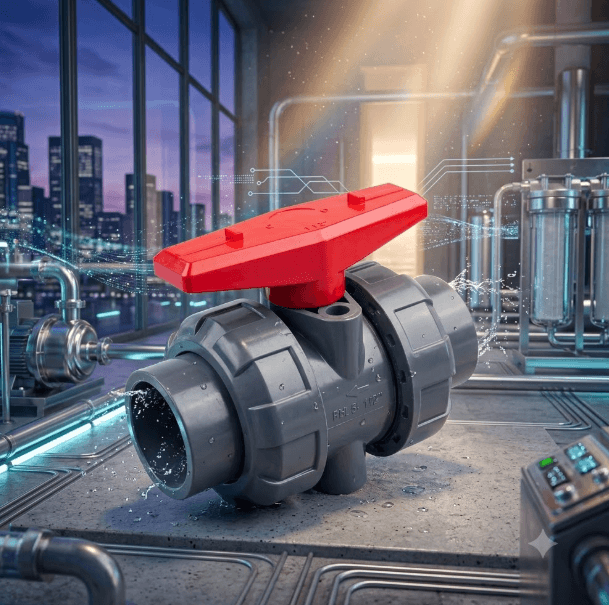
In liquid systems, a manual ball valve typically uses a quarter turn lever, where rotating the ball ninety degrees either aligns its bore with the pipeline to allow flow or turns it perpendicular to stop flow completely. Because the internal parts are few and the design is uncomplicated, manual valves are generally easy to maintain, and any wear on seats or seals can often be addressed without needing to replace the entire unit.
Common Applications of Manual Valves
Manual valves are found in a wide range of settings, from manufacturing equipment and packaging lines to workshop machinery, maintenance stations and general industrial automation systems. They are particularly useful in situations where operator judgment is needed to control flow at a specific moment, rather than relying on a pre programmed or automated response. In water treatment plants, manual valves are often used for isolating sections of pipework during maintenance, ensuring that repairs can be carried out safely without shutting down an entire system.
In chemical processing, manual ball valves with resistant seats and seals allow operators to manage the flow of aggressive media with confidence. Compressed air systems also rely heavily on manual valves, since they allow technicians to test and adjust pneumatic circuits without needing to power up an electrical control system. Even in facilities that are largely automated, manual valves are often kept in place as a backup or override option, giving operators a reliable way to intervene if an electrical or pneumatic failure occurs.
Advantages of Choosing Manual Valves
There are several reasons manual valves continue to be a popular choice, even as automation becomes more common across industries. The first is cost effectiveness, since manual valves are generally less expensive than their electric or pneumatic counterparts, both in terms of initial purchase price and ongoing maintenance. The second is simplicity, as manual valves have fewer components that can fail, which translates into a longer service life and less downtime for repairs.
The third advantage is independence from power sources, meaning that a manual valve will continue to function even during a power outage or in areas where electrical supply is limited or unreliable. This makes them particularly valuable in remote locations or emergency shut off applications where dependability cannot be compromised. Additionally, many manual valves can later be upgraded with an actuator if automation becomes necessary, giving businesses the flexibility to start with a manual solution and expand their system over time without needing to replace existing valves entirely.
Choosing the Right Manual Valve
Selecting the correct manual valve for a given application depends on several factors, including the size of the pipeline, the type of media being controlled, the required pressure rating and the environment in which the valve will operate. For compressed air systems, aluminium bodied valves with pressure ratings suited to standard air supply are typically sufficient, while liquid systems handling water or chemicals may call for stainless steel or PVC bodies with appropriate seat materials such as PTFE or EPDM.
It is also worth considering how frequently the valve will be operated, since valves subjected to constant use may benefit from more durable internal components. Consulting technical data sheets and, where possible, speaking with a knowledgeable supplier can help ensure that the valve chosen will perform reliably for its intended purpose, without unnecessary added expense.
See also: Ways To Revise Bank Exam Syllabus Faster With Topic-Wise Practice
Conclusion
Manual valves remain a dependable and practical solution for controlling the flow of air, water and other media across a wide variety of industrial applications. Their straightforward design, ease of maintenance and independence from electrical power make them a sensible choice whether they are used as the primary control method or as a backup within a larger automated system.
For businesses looking to replace existing components or specify new circuits, a well chosen range of manual valves can offer a cost effective and reliable way to keep operations running smoothly for years to come.