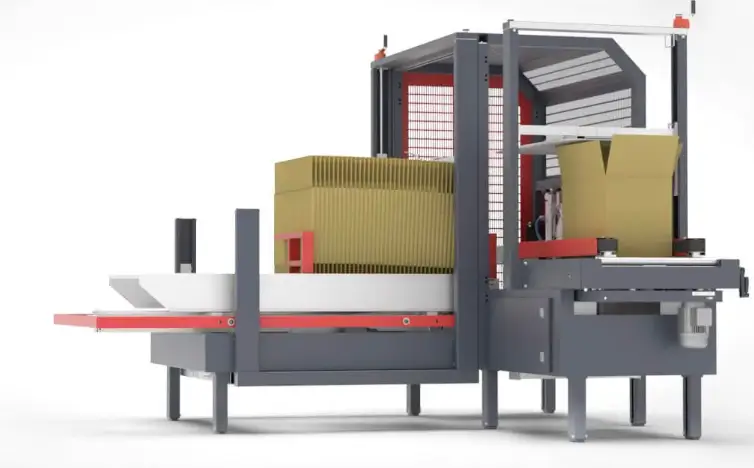
In today’s fast-moving industrial and logistics environment, efficiency in packaging has become just as important as production itself. Every product that leaves a factory must be properly packed, protected, and prepared for transportation. This is where the case erector plays a vital role in modern automated packaging systems.
A case erector is a machine designed to automatically form flat cardboard blanks into fully shaped boxes, ready for filling and sealing. This automation eliminates the need for manual box setup, which not only saves time but also improves consistency and reduces labor dependency.
As global demand for faster production and efficient supply chains continues to grow, case erector machines are becoming an essential part of smart manufacturing and packaging lines.
What Is a Case Erector?
A case erector is an automated packaging machine that takes flat-packed corrugated boxes and transforms them into fully formed cartons. The machine then folds the bottom flaps and seals them using tape or glue, preparing the box for product filling.
These machines are widely used in high-volume production environments where large numbers of boxes need to be prepared quickly and consistently. Instead of relying on manual labor, companies use case erectors to maintain speed and accuracy in their packaging process.
Case erectors are often integrated into fully automated packaging lines along with filling machines, case packers, and sealing systems.
Why Case Erector Machines Are Becoming So Important
The demand for case erector systems is increasing due to the rapid growth of e-commerce, manufacturing, and global distribution networks. Companies are under constant pressure to process large volumes of products efficiently while maintaining packaging quality.
One of the main reasons for adoption is speed. Manual box setup is time-consuming and slows down production lines, especially in high-output environments. Case erectors solve this problem by forming boxes in seconds.
Another major factor is labor optimization. Businesses are shifting toward automation to reduce dependency on manual workers and improve operational efficiency.
Consistency is also a key reason. Automated case erection ensures every box is formed correctly, reducing errors that can lead to product damage during shipping.
See also: Why Data Warehouse Consulting Services Are Critical for Modern Data-Driven Enterprises
Key Benefits of Case Erector Machines
High-Speed Box Formation
One of the biggest advantages of a case erector is its ability to form and prepare boxes at high speed, significantly improving packaging line efficiency.
Reduced Labor Requirements
By automating box setup, companies can reduce manual labor costs and allocate workers to more skilled tasks.
Improved Packaging Consistency
Every box is formed in a uniform shape, which improves stacking, storage, and transportation safety.
Better Production Flow
Case erectors ensure a continuous packaging process, reducing delays and improving overall workflow efficiency.
Applications of Case Erector Machines
The use of case erector technology is widespread across multiple industries due to its versatility and efficiency.
In the food and beverage industry, case erectors are used to prepare boxes for packaged foods, bottled drinks, and frozen products.
In pharmaceuticals, they help create secure packaging for medicine bottles, blister packs, and healthcare products that require precise handling.
In e-commerce and logistics, case erectors play a critical role in preparing shipping boxes for fast order fulfillment and delivery operations.
They are also widely used in manufacturing plants where large-scale packaging is required for distribution.
Types of Case Erector Machines
Different types of case erector systems are available depending on production needs.
Semi-automatic case erectors require some manual assistance but still significantly speed up box formation. Fully automatic case erectors handle the entire process from box picking to sealing without human intervention. High-speed case erectors are designed for large-scale production lines where thousands of boxes are processed per hour.
Each case erector type is designed to meet specific industrial requirements, allowing businesses to choose the right solution for their workflow.
How Case Erectors Improve Industrial Efficiency
Modern packaging systems depend heavily on automation, and case erectors are a key part of this transformation. By automating box setup, they remove one of the most repetitive and time-consuming tasks in packaging operations.
This leads to smoother production flow, reduced downtime, and better synchronization with other machines in the packaging line.
Case erectors also help maintain workplace safety by reducing repetitive manual tasks that can cause fatigue or injury.
Future of Case Erector Technology
The future of packaging automation is closely linked to robotics, artificial intelligence, and smart factory systems. Modern case erector machines are becoming more advanced, with features like automatic size adjustment, real-time monitoring, and predictive maintenance.
With the rise of Industry 4.0, these machines are being integrated into fully connected production systems that allow companies to track performance and optimize efficiency.
As global demand for faster logistics continues to rise, case erectors will remain a key component of automated packaging solutions.
Final Thoughts
The evolution of modern packaging systems has made automation essential for efficiency and scalability. In this transformation, the case erector has become a critical machine that simplifies box formation and improves overall packaging line performance.
Its ability to increase speed, reduce labor costs, and maintain consistency makes it highly valuable for industries such as food production, pharmaceuticals, manufacturing, and logistics.
As technology continues to advance, case erector machines will become even more intelligent and efficient, playing a central role in shaping the future of automated packaging systems worldwide.